
Every unanswered call is a customer going to your competitor. Discover the most common mistakes in phone management and the solution that works in 2026.
The hidden problem that costs thousands of euros
It's 1:30 PM. Your business is busy. The phone rings. Once. Twice. Three times. No one can answer. On the other end, there's a potential customer looking for information or wanting to book. After five rings, he hangs up and calls one of your competitors.
This scene is repeated hundreds of times every day in restaurants, medical offices, beauty salons, repair shops, and shops across Italy. The telephone is still the preferred contact channel for customers (62% according to 2025 data), but it is also the one managed the worst by most small and medium-sized businesses.
In this article, you'll discover the top 5 reasons businesses lose customers through the telephone channel and the technology solution that is transforming customer service in 2026.
📋 THE 5 MAIN REASONS WHY YOU LOSE CUSTOMERS
- 1. Missed calls during peak hours
- 2. Too long telephone waits
- 3. Inadequate answers or incorrect information
- 4. Closures and uncovered hours
- 5. Multitasking management impossible for the owner
✅ SOLUTION: AI Phone Answering System with natural voice, available 24/7
Reason 1: Missed calls during peak hours
Il problema delle chiamate senza risposta
The primary reason businesses lose customers over the phone is paradoxical: you receive more calls precisely when you can't answer. During lunch service at a restaurant, during peak hours at a beauty salon, or when the doctor's office is packed with patients, the phone becomes a problem rather than a business opportunity.
Typical scenario
The dining room is full, the staff are busy with customers, and the kitchen and the operating area are in a rush. The phone rings insistently, but no one can answer. On the other end, a potential customer wants information or to book a service. After a few rings, he hangs up and immediately searches for an alternative on Google.
The numbers of the loss
According to a 2025 study by the Milan Polytechnic on telephone customer service in Italian PMI:
• 73% of missed calls occur during peak hours
• Inoltre, il 68% delle persone che non trovano risposta al primo tentativo non richiama
• Only 12% leave a message on a traditional answering machine
• In media, dopo appena 4 minuti il cliente contatta un concorrente
Conclusion: If you don't respond immediately, the customer will go elsewhere.
Reason 2: Telephone waits that make you hang up
The customer's patience lasts 90 seconds
"Please hold the line, we'll answer as soon as possible..." followed by an irritating tune. It's the sound of customer loss. Industry research shows that the average wait time for an Italian customer on the phone is 90 seconds. Beyond that, the call abandonment rate skyrockets to 65%.
Dove le attese sono più critiche
Gli studi professionali, i centri medici e le attività di servizi sono particolarmente soggetti a questo problema. La segretaria o il receptionist è impegnato con un cliente presente, altre linee sono in attesa, chi chiama sente il segnale di occupato o resta in coda. Nel frattempo ha già cercato su Google un’alternativa disponibile immediatamente.
Every second of waiting exponentially increases the probability of losing the customer.
| Waiting time | % Abandonment | % That goes elsewhere |
|---|---|---|
| 0-30 seconds | 5% | 10% |
| 30-90 seconds | 25% | 40% |
| 90-120 seconds | 65% | 82% |
| Over 120 seconds | 85% | 92% |
Source: Customer Service Observatory Italy 2025
Reason 3: Inadequate answers or incorrect information
When answering is worse than not answering
The phone is answered, but by the wrong person or at the wrong time. The new employee isn't familiar with all the services. The person answering doesn't have immediate access to price lists or availability. The result? Vague, uncertain, and unprofessional information that alienates potential customers instead of winning them over.
Real-world example of poor call handling
Customer: “Good morning, do you also do [specific service]?”
Operator: “Um… I think so, but I’m not sure. You should call back later when the owner is there.”
Customer: (Hangs up and searches Google for a more professional alternative)
The customer won't call back. He'll immediately look for a competitor who answers with confidence and competence.
Why does it happen?
• Staff turnover – respondents change frequently and don't know everything
• Services or price lists that change and not all are updated
• Staff not adequately trained in telephone communication
• Lack of easily accessible documentation
• Pressure of the moment – responding while managing other tasks
Consequence: The customer perceives disorganization and a lack of competence. Even if your service is excellent, a negative first impression over the phone ruins everything.
Reason 4: Closures and uncovered hours
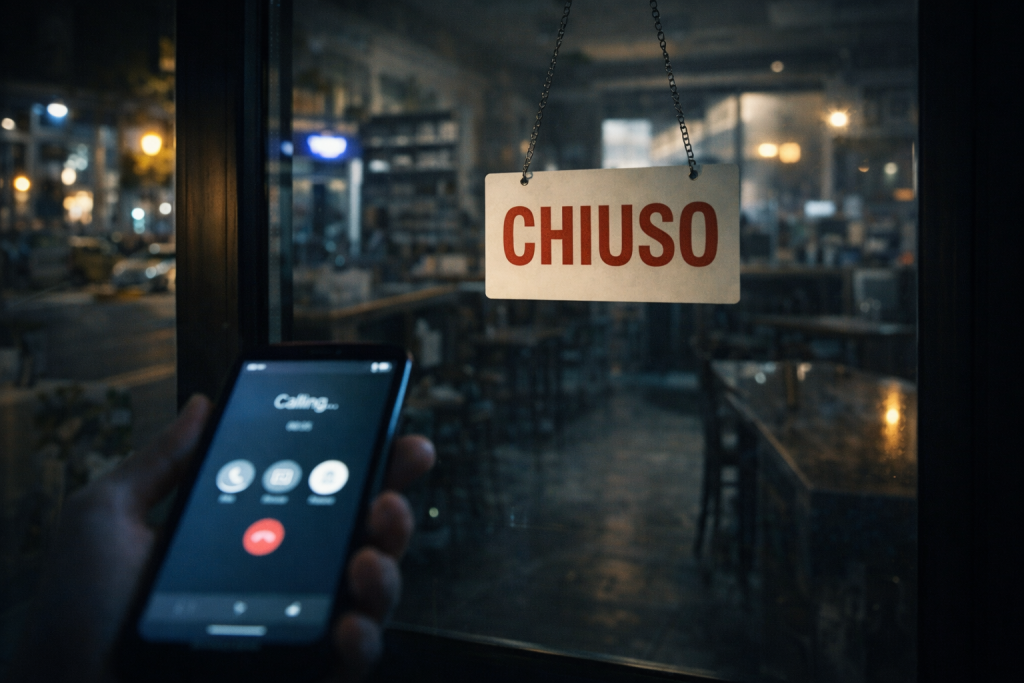
The customer seeks information when you are not therei
Does your phone only ring when you're open? Wrong. People are looking for information, wanting to make reservations, and having questions at 10:00 PM, on Sunday afternoons, or during summer holidays. In 2026, consumers expect immediate answers 24/7, regardless of your opening hours.
Scenario critico: il weekend
It's Friday evening at 8:30 PM. A potential customer is looking for service the next day. He calls five local businesses:
• Activity 1: Phone rings in vain (closed)
• Activity 2: Generic answering machine “We are closed, please call back during office hours”
• Activity 3: Phone busy
• Activity 4: Rings 10 times with no answer
• Activity 5: Intelligent auto responder that provides information and collects the request
Guess which business the customer acquires? The only one that was "available" when the others weren't.
The critical moments when you lose the most customers
• Lunch break (1:00-3:00 pm) – if you close you will lose calls for the afternoon/evening
• After 7pm – for businesses that close early
• Weekend – for offices and professional studios
• Holidays – when people have time to look for services
• Holiday periods – 2-3 weeks of completely missed calls
KEY DATA: 42% of sales calls occur outside of standard business hours (Source: Telecommunications Observatory 2025)
Reason 5: Multitasking is impossible
The Entrepreneur's Dilemma
You're simultaneously the owner, manager, operations manager, and phone operator. But it's physically impossible to do everything well at the same time. Serving customers, managing operations, coordinating the team, and answering the phone: something is bound to give. And all too often, it's the phone.
The case of the professional
You're a dentist, a lawyer, a physical therapist. You're treating a patient or client. The phone rings. You have only two options:
1. You ignore the phone – you miss the call and the potential new customer
2. Stop the activity – bad experience for the person in front of you
Both options are wrong, but you are forced to choose.
The problem of hiring
Many entrepreneurs consider hiring a dedicated telephone person:
• Significant monthly cost for a part-time or full-time position
• Calls do not arrive evenly (peaks and dips)
• Holidays, illnesses, breaks still create overdrafts
• It is often not economically sustainable for a small business
The vicious circle
You lose customers on the phone → Less revenue → You can't afford to hire → You keep losing customers → The cycle repeats itself
How much does each missed call really cost?
Let's do some concrete calculations to understand the real economic impact of missed calls.
Example calculation for catering activities
Starting data:
• 30 calls received every day
• 27% missed calls (conservative estimate): 8 calls
• 60% of missed calls were booking requests
• Missed convertible calls: approximately 5 per day
Weekly calculation: 5 calls × 6 days = 30 missed opportunities
Annual calculation: 30 × 52 weeks = 1,560 lost business opportunities
With an average opportunity value of €50-70, we're talking tens of thousands of euros in potential lost revenue every year.
IMPORTANT NOTE: These are conservative calculations. The reality for many businesses is even worse.
| Sector | Typical calls/day | Estimated losses (25-30%) | Estimated annual impact |
|---|---|---|---|
| Restaurant | 30-50 | 8-15 | High |
| Medical/dental practices | 20-35 | 5-10 | Medium-High |
| Beauty salons/hairdressers | 25-40 | 7-12 | Medium-High |
| Workshops/body shops | 15-30 | 4-8 | High |
| Hotel/B&B | 20-35 | 5-10 | High |
| Professional studies | 10-25 | 3-7 | Medium |
The 2026 Solution: AI Telephone Answering
Why traditional solutions no longer work
Until a few years ago you only had three options for managing calls:
1. Classic answering machine
Generic recorded message, no real interaction. Only 8-12% leave messages.
2. Human receptionist or secretary
Personalized interaction but high cost, limited hours, problems with holidays and illnesses.
3. External call center
Broad coverage but very high costs, impersonal service, operators who don't know your business thoroughly.
Nel 2026 esiste una quarta opzione che combina i vantaggi di tutte eliminando gli svantaggi.
| Solution | Pro | Against | Effective? |
|---|---|---|---|
| Classical secretariat | Free | Nessuno lascia messaggi | ❌ |
| Human receptionist | Customized | Expensive, limited hours | ⚠️ |
| Call center | Hourly coverage | Very expensive, impersonal | ⚠️ |
| AI Assistant | 24/7, natural, scalable | Requires initial setup | ✅ |
Come funziona il Risponditore Telefonico AI
Un assistente virtuale con voce umana naturale risponde alle chiamate al posto tuo:
1. Incoming call – Customer dials your number
2. Instant response – The AI answers within 2 rings with a natural Italian voice
3. Fluid conversation – The customer speaks normally, the AI understands and responds
4. Information Access – AI knows your business's opening hours, services, prices, and availability
5. Concrete action – Book appointments, provide information, collect requests
6. Intelligent transfer – If necessary, transfer the call to you for complex cases
7. Complete reporting – Receive notification and transcription of every call handled
Main features
✅ Natural human voice in Italian (no robot effect)
✅ Available 24/7/365
✅ Handles simultaneous calls (no busy signal)
✅ Connects to your existing phone number
✅ Calendar synchronization for appointment management
✅ Real-time notifications via SMS, email or WhatsApp
✅ Complete monitoring dashboard
✅ Continuously learn from conversations
No missed calls. No waiting for customers. Always accurate information.
How to delete missed calls in 48 hours
If you recognize yourself in at least 3 of the 5 reasons described in this article, it's time to take action.
Step 1: Assess how much you're losing (10 minutes)
First of all, quantify the problem:
• How many calls do you receive on average per day?
• How much do you lose, estimated? (calculate 20-30%)
• How many of those lost were business opportunities? (50-70%)
• What is the average value of a sale/booking/service?
Calculate: missed calls × % sales × average value = daily loss
Multiply by 250-300 working days = annual loss
Step 2: Request a free personalized analysis (30 minutes)
Contact WhoSpeaking for a customized analysis of your business:
• Specific call volume analysis
• Identification of the most critical times
• ROI estimation for your industry
• Live demo of the AI assistant in action
Step 3: Quick custom setup (48-72 hours)
Day 1: Technical setup
Connection to your existing phone number, voice setup and assistant personality
Day 2: AI Training
Upload information about your business (hours, services, policies), configure the most common FAQs
Day 3: Tests and simulations
Test calls with various scenarios, listening to recordings, final optimization
Day 4: Activation
Go live with dedicated monitoring and support
Step 4: Continuous monitoring
Real-time dashboard where you can control:
• Number of calls handled by AI
• Average conversation duration
• Bookings or requests collected
• Calls forwarded to you
• Complete transcripts of all conversations
• Weekly reports and statistics
Artificial intelligence is constantly learning: the more it works, the more effective it becomes.
Don't lose any more customers
Every day that passes without resolving your phone management issue, you lose real customers. Not hypothetical customers, but people who contacted you, wanted to purchase your services or products, and chose a competitor simply because you didn't answer the phone.
The good news? Solving this problem is easier and more cost-effective than ever. It doesn't require major investments or new hires. All you need is the right technology applied to your specific business.
Final question: How much is it worth to you to never lose a customer on the phone again?